Thursday, May 24, 2007

The Big Emtpy by JB Stephens

This book provides a fair foundation for teens' science fiction reading. After a horrible plague decimates the American (and probably the world's) population, martial law is instated by a self-proclaimed President, and the surviving population of the interior US is relocated to the coasts. There are renegades, however, who refuse to leave--and there is a settlement somewhere in the Midwest of people who want to live a different way. The story follows a group of teens who either leave the 'safety' of the military state to look for this settlement, or they just happen across the others who are looking for it.

The number of characters in the book is its only complexity, but for those who are unfamiliar with science fiction, that may be enough. (A simple plot is not necessarily a bad thing, and this is the first in a series, so perhaps it will get more complex.)

At least they stay in one time period--this is not the kind of science fiction that involves time travel, space travel, light sabers or moleculizers.

Teens who like this should try Stephen King's The Stand and Margaret Atwood's Oryx & Crake.

The Sledding Hill by Chris Crutcher

This is a book about grief and censorship. Crutcher draws from his own experiences (as always) to mold this story of a boy who lost his father and his best friend within a month of each other, and how books--his right to choose what he reads--helps him to remember and honor his father and his friend through his actions.

I particularly appreciate the way that the narrator points out this this story has no real "villain"--because everyone has good, honorable intentions--even though it's very clear who the antagonists are. No one is behaving badly just for the sake of behaving badly. As so many are, the conflicts in this book are about of ideas and ideals.

I was also amused that Crutcher wrote himself into the story--not just as a fraction of the characters, but as Chris Crutcher the Challenged/Banned Books Writer (in this case, the book Warren Peace).

As always, Crutcher writes to encourage teens to think for themselves, to not automatically buy into the beliefs of family and friends without their own examination of the implications of those beliefs. The book also serves as encouragement to read his other books, since he writes about the aspects of his books that are so often challenged, and as he points out, there's not really a better way to ensure that teens will read these books than to suggest or tell them that they're not allowed to.

Wednesday, May 16, 2007

King of the Mild Frontier: An Ill-Advised Autobiography by Chris Crutcher

Chris Crutcher's autobiography will alter the way you read his books. It is enjoyable, even when he shares some of his more humiliating moments. Know all those things you did when you were young and stupid and you hope they never come up as conversation when you bring your significant other to meet the family because you don't want him/her to know just how stupid you've been, even as a kid? Crutcher confesses to many of those things. Many of these incidents, for Crutcher, seem to have been instigated by his brother (on the premise that the result would be "neat"), and you will wonder, when you've finished, what other stories were cut or left out.

You will also see many of his characters floating through the pages--athletic or otherwise--and you will probably never read his books the same way again, because the characters will become a little more real for you. For me, this is distracting--I would far prefer to be reading this book after I've read all his others, and saying, "Oh, this happened to [this character] in [this book]," instead of reading his fiction and thinking, "I remember--this happened to [so-and-so] when he was in high school," or whatever. Knowing the real background pulls me out of the fiction a little too much. Even when you know that the stories must be based on real experiences Crutcher has had or known, it's very different to know the real stories when you're reading fiction.

So, by all means, read this book. It's funny, sad, and I wish there was more of it. But if you suspect you're like me, wait till you've read all his other books before cracking this one.

The Higher Power of Lucky by Susan Patron

I found this to be a delightful book. The book follows Lucky, fearless and compassionate, whose mother died after being struck by lightning, whose father doesn't want her, and who is therefore being raised by her father's first wife. Her friends are her dog, her classmate Lincoln who is obsessed with tying knots, and little Miles who takes a copy of Are You My Mother? everywhere.

Lucky is a girl with moxie. Her fear: that her guardian Brigitte is leaving her to go back to France. But Lucky knows what she wants, and she has ideas about how to get it. Misguided though she may be, she's the kind of bold that even adults envy. And she's determined to figure out how to find her higher power--something she's heard about while eavesdropping on various 12-step programs--because she is convinced that finding this mysterious higher power is going to make everything all right.

The unusual setting and the enchanting and well-flawed array of characters make this a warm, memorable book. I especially like Lincoln, and his affinity for proper punctuation.

Monday, April 30, 2007

Eragon by Christopher Paolini

Eragon is not a great book. It's not even a good book. I like the fantasy genre, and I like teen and YA books, but I could not get past the tedious dialogue and convenient contrivances of the plot. I got to a point where I dreaded opening the book to face another page. It isn’t even original—just a composite of other fantasy series.

And I’m mad that so many well regarded review sources showered praise upon this book. For shame. Those people should know the difference between good writing, and teenage writing that may someday be morphed into something much better.

Saturday, March 31, 2007

Over My Head by Claudia L. Osborn

Claudia Osborn loved being a doctor, but when a truck hit the bicycle she was riding, her life changed forever. This book recounts her injury and recovery/rehab, focusing on the rehab process which was, for her as a doctor, a particularly harrowing experience. I was amazed as she, time and again, somehow managed to get herself to her place of rehab, right in the middle of Manhattan, which, with all of its bustle, is a far cry from the ideal place for a person with brain injury. Osborn frankly writes of her inability to process her surroundings, her inability to remember processes that people without brain injuries take for granted like getting ready to go out for the day--showering and getting dressed--or buying groceries. In one memorable chapter, she thinks she has tissues in her pocket, only to, step by step, realize that what is in her pocket is the bra she was supposed to wear that day. It takes her five or six steps, including actually removing and uncrumpling the bra, to realize this. Osborn’s straightforwardness is, at times, unnerving.

As a memoir written by a person who suffered brain injury (most brain injury memoirs are written by parents or spouses), this book offers a unique and very readable perspective. Osborn, while she obviously loved the life she had, openly shares her process of learning to accept her new limitations and to reshape her life to accentuate her remaining and new skills.

Saturday, March 03, 2007

Better Than Running at Night by Hillary Frank

Better Than Running at Night is about an art student named Ellie and her attempt to create/define a relationship in terms of love, physical attraction, and sex. Her other pursuit—art—seems secondary and fairly effortless. Ellie is a normal college freshman; more so, perhaps, than her peers at art school (who go out of their way to be extremely weird), which serves to make her a more sincere narrator. The story itself, however, involves too much navel-gazing, which will be tiresome for readers older than the teen crowd the book is intended for. Ellie is a passive narrator, and her fellow characters remain pretty static from beginning to end, seeming more like the objects Ellie draws than characters. What compels the reader to keep going is merely to see how it ends, not any particular investment in the outcomes for any of the characters. But at least it does compel the reader to keep reading.

Ellie’s narrative voice is frank, and at times it's funny, even witty; when it is, her voice is similar to the narrator of Speak (by Laurie Halse Anderson). The short chapters also remind me of Speak, which may encourage readers with short attention spans to give this book a try. Also appealing to its teenage audience will be the steamy (but not smutty) sex scenes.

(Readers of this book should be in at least high school; the sexy parts would probably be a bit much for middle school readers, and I’m pretty sure most parents would be appalled to find their 7th or 8th graders reading this.)

Wednesday, February 21, 2007

Where is the Mango Princess? by Cathy Crimmins

No one is immune to brain injury, and that is just one reason this memoir is well worth reading. Crimmins skillfully weaves perfect proportions of pain, grief, fear, humor, and facts and statistics to tell her story, and secondarily, her husband’s. Her recountings of post-injury Alan are contrasted with descriptions of pre-accident Alan, a successful trusts and estates officer, and thus, Crimmins offers us a complete picture of what exactly she has lost. You also won't find her ranting about American health care and HMO’s, though she's given reasons galore, and it would be easy for her to drown the narrative with a woe-is-me attitude, but instead, she has obviously taken much care to make sure that this story resists self-pity or sappiness. She includes painful, intimate stories—because they are necessary to completely tell this story—without being crass or trying to create a buffer for her or her husband's roles. And in no way does Crimmins try to protect, nor to unnecessarily horrify, the reader.

Brain injury stories are not easy to read. You will experience, to lesser degrees, what Crimmins experienced, and more remarkably, you will want to keep reading, even when it hurts—especially when it hurts.

Nine Parts of Desire by Geraldine Brooks

I found this book at Grounds for ThoughtLink, my favorite used bookstore/coffeeshop. Though it's a decade old, written several years before 9/11, I thought that it would provide a good platform for beginning to understand the life of Muslim women in Middle Eastern cultures. It seemed straightforward, and since Brooks is a journalist, the book seemed even more promising. I hoped that meant that she would be likely to produce a more unbiased interpretation of events as she experienced them.

Full of stories from nearly every country in the Middle East, Nine Parts of Desire did prove to be enlightening. Brooks seems to have befriended many people in her time as a foreign correspondent, and to have gleaned an appreciation for the beautiful parts of the cultures, and horror for those customs she (with her Australian upbringing) finds ridiculous. She shows how Muslim practices vary from country to country, and even within a country. Early on, she explains the roles of Muhammad's wives and daughters, particularly the two that Brooks claims is responsible for the splitting of Islam into two groups: Sunnis and Shiites.

Brooks's stories are interesting, sometimes beautiful and sometimes abhorrent, and while she cannot completely hide her disdain for many customs, especially the coverings women are forced to wear in some cultures, she does an admirable job of trying to respectfully present a Middle Eastern world to those of us who know little or nothing about it. I'm sure that many readers will find plenty to argue with, but since I know next to nothing about the subject matter at this point, and am only using this as a springboard to learn more, I found it adequately educational, and certainly intend to continue learning more.

Friday, November 24, 2006

Adverbs by Daniel Handler

My students loved The Series of Unfortunate Events, so when I saw that Daniel Handler/Lemony Snicket had written a book called Adverbs (I'm a sucker for a good part of speech), I had to read it.


You can't read this book like you would any other book. I tried to, for the first three or four chapters, and in chapter five, I realized that this book isn't stable. The characters don't stay the same. It's not just that they're dynamic characters, it's that the characters literally aren't the same from chapter to chapter. People who seemed to have something to do with Andrea or David in chapter one don't have anything to do with the Andrea in chapter six or thirteen (I'm making these numbers up--I had to return the book to the library and don't have it on hand to refer to).


I never quite stopped trying to connect one David to another, but everyone started blurring together. The result, other than confusion, is that everyone eventually seemed to be living the same, or at least similar, story.


If you've ever read Tim O'Brien's The Things They Carried, you know how he retells several stories, and how details change in the retellings. Well, Adverbs is like that but on speed or cocaine or something. The characters live in a topsy-turvy world where half the people are expecting a huge disaster. The characters are, themselves, topsy-turvy. It all makes for a brilliant, if jarring ride.

Tuesday, November 07, 2006

A Map of the World by Jane Hamilton

This book had its moments. Maybe it would have had more, but I stopped reading 2/3 of the way through. I couldn't muster enough concern about Alice or her husband or their children to make the last third of the book worthwhile. I don't even care whether Alice did what she was accused of or not.

Sunday, November 05, 2006

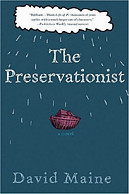
The Preservationist by David Maine

There's nothing new under the sun. Plots are plots. Everything just gets reinvented. This I was told in high school English.

My latest successful reading endeavor is The Preservationist by David Maine, which is a reinvention of the story of Noah and the ark. Rewriting mythological stories has become a popular idea, though it's not an uncommon one--writers like Jeannette Winterson, Piers Anthony, and (my favorite) Robin McKinley have been reinventing myths and fairy tales for a long time. The Mists of Avalon by Marion Zimmer Bradley is a famous and wonderful reseeing of Aruthurian legends, and Margaret Atwood has rewritten the myth of Penelope and Odysseus. I could delve here into questioning just how new or original any of these stories are, how new they can be made. Mostly, I suspect it would become an inspection worthy of a Women's Studies paper, since most retellings seem to focus on previously unconsidered female points of view.

Instead (and for now), I'll stick to the book at hand. David Maine's The Preservationist tells the story of Noah and his family in the days of ship-building, the flood, and the days after. Just about everyone's perspectives are covered--Noah's, his wife's, and Noah's sons and daughters-in-law. Noah's wife doesn't have a name and is only referred to as "the Wife." Two of his daughters-in-law are from southern and northern tribes; one of them sounds strikingly like a 20th century, almost man-hating feminist, grating under the patriarchy it seems she has just been exposed to, though she had allegedly been married to Noah's son for several years. This isn't the only 20th century-esque bit in the book; there's also the use of "rut" as an alternative to "f---", so you get a lot of "Rut you"s between the brothers. That brought me out of the book quite a bit. And then there are frequent references to literaly rutting (but no details, so don't go paging through the book for smutty sections...

We're not really sure what to think of the characters because we spend so little time in their heads and so much time being told the others' thoughts of them. At some point, two of the sons seem to switch personalities. The most constant characters were Noah himself and his youngest daughter-in-law (who's a bit flaky and though you might think that this wouldn't be difficult to keep consistent, it's actually pretty hard to not make not-so-bright characters suddenly smarter). With the inconsistencies, it would feel like an underdeveloped book in the end, if there wasn't so much "rutting" going on that any more would have become tedious.

Overall, it was an entertaining read, even if I haven't made it sound like it. (Keep in mind that I did finish reading the book.) At least, it was entertaining as long as I didn't think too hard.

Monday, October 16, 2006

Last Notes and Other Stories by Tamas Dobozy

I know I said that I'm not usually drawn to short stories, but . . . .

Last Notes is, foremost, a collection of character studies. The character holds more sway than setting or plot. And no character exists as comedy relief. Each occupies his(/her) own space and insists on being taken seriously, even while tottering on the edge of madness.

Subjects which would easily lead other authors to humorous writing are instead treated with all formality, credibility, and compassion, even in "Phillip's Killer Hat," the story of two brothers, one with an unidentified mental illness and the other who acts as his caretaker and his foil, and in "The Man Who Came out of the Corner of My Eye," the story of a man who alienates himself from his friends and his wife and then begins to see and hear a man who only appears in his peripheral vision, and who claims to want to make a business of helping people detach from their friends and family.

I found myself thinking fondly of literary critics (only because I don't have to tease out these ideas unless I actually want to) and what they would have to say about the resistance of the Hunagrian immigrant characters to accept Canada as 'home'. What would be made of the woman in "Tales of Hungarian Resistance" who had no stories of her own to tell, but only commentary based on her husband's stories? or of the two main characters who box out their marital issues in "Into the Ring"? And then there's "Radio Blik," a story with postmodern tendencies, and so many other critical crevices that I would have to turn to my old literary criticism book to even get started.

Dobozy's collection was a fast and furious switch from Carol Shields's stories. I found it harder to read cover to cover because the humor was darker, less playful, but no less impressive for its more serious nature.

Like a rich seven course meal, these stories are not to be ingested in giant gulps, but in small bites. Each story needs to be given time to settle before moving onto the next course; to try to inhale these experiences like a lunch in less than half an hour would be a mistake. This is a collection to savor.

Monday, October 02, 2006

Maid Marian: A Novel by Elsa Watson

I picked this up at a local bookstore. I've enjoyed Robin Hood literature in the past, and thought I would give Elsa Watson's book a try. Though it's easy to read, I am disappointed that the author doesn't take more liberties with the story. The characters are mostly flat, even Robin Hood.

Watson, through Marian, informs the readers of what they are to understand about the characters, rather than to let the characters' actions speak for themselves, and more often than not, the author's idea for the plot seems to define the characters and drive their (sometimes jarringly uncharacteristic) actions rather than the other way around.

If you're in the mood for a tale of Sherwood Forest, I would find another. If you're particularly interested in Marian's perspective, I would recommend Lady of the Forest by Jennifer Roberson. You'll find more interesting adventures and more developed characters, and (as I recall) far less character navel-gazing.

Dressing Up for the Carnival by Carol Shields

I don't usually go for short story collections when I select what to read next. Maybe they remind me too much of forced readings from school (both from my days as a student and as a teacher). Or maybe I've just been confused by what was supposed to be top notch writing in upper tier publications because I didn't understand them, or what about them was considered good. Lately, though, I've found myself gravitating towards a few different authors, just to try them out. First was Alice Munroe, whose collection Runaway I enjoyed, but I gave up on whichever collection I tried to read next.

Then came Dressing Up for the Carnival. This collection of stories--truly short, with the longest story being a mere 20 pages--is easy and pleasurable to read. I particularly enjoyed Shield's playful sense of language. "Absence" was delightful, ticklish to the intellect, a story about a writer with a stuck key on her keyboard ("But after she had typed half a dozen words, she found that one of the letters on the keyboard was broken, and to make matters worse, a vowel, the very letter that attaches to the hungry self."). Shields herself doesn't use an instance of that vowel in her story.

I intend to reread Dressing Up for the Carnival, to peel away some of the skins of the stories, because I'm quite certain I will love this book all the more for a second reading, and find quite a different collection underneath than the first reading presented me with. Other stories that I look forward to re-encountering are:
  • "Ilk"--the meeting of a pair of English professors at a conference; the narrative (as a mode) is treated almost as a debatable scientific phenomenon.
  • "Windows"--a couple of artists find the recently imposed "window tax" a new challenge to their creativity.
  • "Weather"--all of the nation's weathermen go on strike, and the country suffers a subsequent lack of weather.
  • "A Scarf"--an author on tour decides to search for the perfect scarf for her daughter.
I suppose I could just list them all.
_________________________

About the book, from Random House of Canada